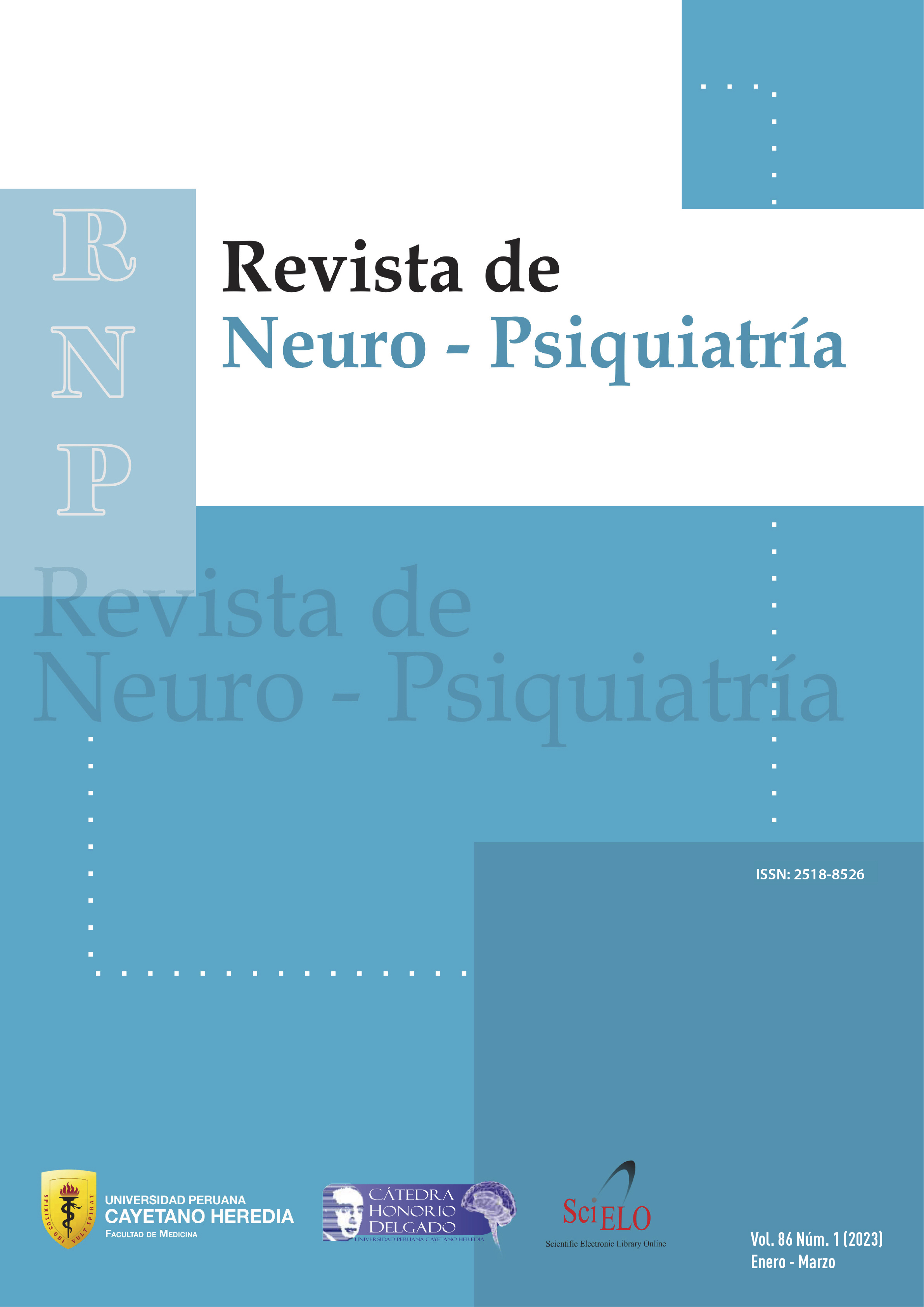
Conocimiento sobre psiquiatría antes y después de la pandemia: una evaluación mediante el examen del curso básico de mhGAP
DOI:
https://doi.org/10.20453/rnp.v89i2.7645Palabras clave:
Salud mental, psiquiatría, trastornos mentales, educación médica, conocimientoResumen
Objetivo: Determinar el nivel de conocimiento en psiquiatría y salud mental de los externos de medicina de una Facultad de Medicina, mediante la aplicación de la prueba del curso básico del Programa de Acción para la Brecha de Salud Mental (PCB-mhGAP). Metodología: El estudio fue descriptivo. La recolección de los datos generales y las respuestas de la PCB-mhGAP fue de tipo transversal. Resultados: Los estudiantes que realizaron una rotación electiva en psiquiatría obtuvieron un mayor puntaje en la PCB-mhGAP en comparación con quienes no la hicieron (β = 1,90; IC 95%: 0,94-2,87; p < 0,001). Los puntajes de conocimiento sobre psiquiatría y salud mental fueron más bajos en los estudiantes del externado durante el período 2022 (postpandemia) en comparación con aquellos del período 2019 (prepandemia) (14,44 ± 4,25 vs. 15,57 ± 1,89; p = 0,048). Conclusiones: Los estudiantes que realizaron una rotación electiva en psiquiatría tienen un mayor puntaje en la PCB-mhGAP. Los puntajes pospandemia de la PCB-mhGAP fueron menores que los obtenidos en prepandemia. Hasta donde sabemos, este es el primer intento de explorar en nuestro país el nivel de conocimiento adquirido por los estudiantes de pasantía mediante la PCB-mhGAP.
Descargas
Citas
World Health Organization. World Mental Health Report: Transforming mental health for all [Internet]. Geneva: WHO; 2022. Available from: https://iris.who.int/bitstream/handle/10665/356119/9789240049338-eng.pdf
Patel V, Saxena S, Lund C, et al. The Lancet Commission on global mental health and sustainable development. Lancet. 2018;392(10157):1553–98. doi:10.1016/s0140-6736(18)31612-x
COVID-19 Mental Disorders Collaborators. Global prevalence and burden of depressive and anxiety disorders in 204 countries and territories in 2020 due to the COVID-19 pandemic. Lancet. 2021;398(10312):1700–12. doi:10.1016/S0140-6736(21)02143-7
Errazuriz A, Avello-Vega D, Passi-Solar A, et al. Prevalence of anxiety disorder in Latin America: a systemic review and meta-analysis. Lancet Reg Health Am. 2025;45:101057. doi:10.1016/j.lana.2025.101057
Buedo P, Daly T. A contextual understanding of the high prevalence of depression in Latin America. Lancet Reg Health Am. 2024;32:100717. doi:10.1016/j.lana.2024.100717
Kohn R, Ali AA, Puac-Polanco P, et al. Mental health in the Americas: an overview of the treatment gap. Rev Panam Salud Pública. 2018;42:e165. doi:10.26633/rpsp.2018.165
Chaulagain A, Pacione L, Abdulmalik J, et al. WHO Mental Health Gap Action Programme Intervention Guide (mhGAP-IG): the first preservice training study. Int J Mental Health Sys. 2020;14(1):47. doi:10.1186/s13033-020-00379-2
World Health Organization. [mhGAP intervention guide for mental, neurological and substance use disorders in non-specialized health settings: mental health Gap Action Programme (mhGAP), version 2.0] [Internet]. Geneva: WHO; 2016. Available from: https://apps.who.int/iris/handle/10665/250239 Spanish.
Keynejad R, Spagnolo J, Thornicroft G. WHO mental health gap action programme (mhGAP) intervention guide: updated systematic review on evidence and impact. Evid Based Ment Health. 2021;24:124–30. doi:10.1136/ebmental-2021-300254
Saavedra JE, Aliaga K, Castillo WH, et al. [Epidemiological study on the impacto of the COVID-19 pandemic on the mental health of the population of Metropolitan Lima]. Diagnóstico. 2022;61(3):147–86. doi:10.33734/diagnostico.v61i3.374 Spanish.
World Health Organization. Mental Health and COVID-19: Early evidence of the pandemic’s impact. Scientific brief: 2 March 2022 [Internet]. WHO; 2022. Available from: https://www.who.int/publications/i/item/WHO-2019-nCoV-Sci_Brief-Mental_health-2022.1
Ahmed H, Allaf M, Elghazaly H. COVID-19 and medical education. Lancet Infect Dis. 2020;20(7):777–8. doi:10.1016/S1473-3099(20)30226-7
Darnton R, Lopez T, Anil M, et al. Medical students consulting from home: a qualitative evaluation of a tool for maintaining student exposure to patients during lockdown. Med Teach. 2021;43(2):160–7. doi:10.1080/0142159X.2020.1829576
Byrne MH, Alexander L, Wan JC, et al. Clinical support during COVID-19: an opportunity for service and learning? A cross-sectional survey of UK medical students. Med Teach. 2023;45(8):859–70. doi:10.1080/0142159X.2023.2184235
Wang W, Li G, Lei J. The impact of COVID-19 on medical students. GMS J Med Educ. 2024;41(1):Doc10. doi:10.3205/zma001665
Wilson I, Shankar PR. The COVID-19 pandemic and undergraduate medical student teaching/learning and assessment [version 1]. MedEdPublish. 2021;10:44. doi:10.15694/mep.2021.000044.1
Grant L, Singh L, Fristad MA, et al. Outcomes of medical student elective in child and adolescent psychiatry: a pilot study. Med Sci Educ. 2025;35(4):1861–5. doi:10.1007/s40670-025-02381-0
Zavorotnyy M, Klatte S, Yang Y, et al. The effects of a psychiatric clerkship on stigmatizing attitudes toward mental disorders as held by German medical students. Front Psychiatry. 2023;14:1306403. doi:10.3389/fpsyt.2023.1306403
Lyons Z, Janca A. Impact of a psychiatry clerkship on stigma, attitudes towards psychiatry, and psychiatry as a career choice. BMC Med Educ. 2015;15(1):34. doi:10.1186/s12909-015-0307-4
Economou M, Kontoangelos K, Peppou LE, et al. Medical students’ attitudes to mental illnesses and to psychiatry before and after the psychiatric clerkship: training in a specialty and a general hospital. Psychiatry Res. 2017;258:108–15. doi:10.1016/j.psychres.2017.10.009
Taylor DC, Hamdy H. Adult learning theories: implications for learning and teaching in medical education: AMEE Guide No. 83. Med Teach. 2013;35(11):e1561–72. doi:10.3109/0142159X.2013.828153
Terregino CA, Byerley J, Henderson DD, et al. Cultivating the physician workforce: recruiting, training, and retaining physicians to meet the needs of the population. Med Teach. 2021;43(Suppl 2): S39–48. doi:10.1080/0142159x.2021.1935832
Dost S, Hossain A, Shehab M, et al. Perceptions of medical students towards online teaching during the COVID-19 pandemic: a national crosssectional survey of 2721 UK medical students. BMJ Open. 2020;10(11):e042378. doi:10.1136/bmjopen-2020-042378
Wilkes FA, Looi JC, Maguire PA, et al. Online medical student OSCE examinations during the first three years of the COVID-19 pandemic compared to three years pre-pandemic: an Australian experience in psychiatry and addiction medicine. Med Teach. 2024;46(6):776–81. doi:10.1080/0142159X.2023.2279918
Torda A, Shulruf B. It’s what you do, not the way you do it – online versus face-to-face small group teaching in first year medical school. BMC Med Educ. 2021;21(1):541. doi:10.1186/s12909-021-02981-5
TMS Collaborative. The perceived impact of the Covid-19 pandemic on medical student education and training – an international survey. BMC Med Educ. 2021;21(1):566. doi:10.1186/s12909-021-02983-3
Ahmed H, Allaf M, Elghazaly H. COVID-19 and medical education. Lancet Infect Dis. 2020;20(7):777–8. doi:10.1016/S1473-3099(20)30226-7
Lee IR, Kim HW, Lee Y, et al. Changes in undergraduate medical education due to COVID-19: a systematic review. Eur Rev Med Pharmacol Sci. 2021;25(12):4426–34. doi:10.26355/eurrev_202106_26155
Sarabia SV. Sintomatología depresiva según PHQ-9 y rendimiento académico en estudiantes de primero a quinto año de Medicina [master’s thesis on the Internet]. Lima: Universidad Peruana Cayetano Heredia; 2017. Available from: https://hdl.handle.net/20.500.12866/838
Descargas
Publicado
Cómo citar
Número
Sección
Licencia
Derechos de autor 2026 Silvana Sarabia, Horacio Vargas-Murga

Esta obra está bajo una licencia internacional Creative Commons Atribución-NoComercial 4.0.