La Ética de la Generación Z
DOI:
https://doi.org/10.20453/ah.v69i1.8144Descargas
Citas
Benavides, M., León, J., Haag, F., y Cueva, S. (2015). Expansión y diversificación de la educación superior universitaria, y su relación con la desigualdad y la segregación (Documento de Investigación N.º 78). GRADE. https://grade.org.pe/publicaciones/expansion-y-diversificacion-de-la-educacion-superior-universitaria-y-su-relacion-con-la-desigualdad-y-la-segregacion/
Castilleja Vargas, L., y Enciso, S. (2019). El patrón de crecimiento y la expansión de la clase media en Perú (Nota Técnica IDB-TN-1710). Banco Interamericano de Desarrollo. https://doi.org/10.18235/0001843
Caycho Caja, A. (2019). Sociopsicología de la anomia. Revista de Investigación en Psicología, 21(2), 285-300. https://doi.org/10.15381/rinvp.v21i2.15828
Cerezo, P. (2016). La Generación Z y la información. Revista de Estudios de Juventud, (114), 95-109. https://www.injuve.es/sites/default/files/2017/28/publicaciones/documentos_7._la_generacion_z_y_la_informacion.pdf
Ehrenfeld Lenkiewicz, N. (2016). Las violencias y los jóvenes universitarios, una experiencia para reflexionar. Trabajo Social, (18), 93-110. https://www.redalyc.org/journal/6844/684471951007/684471951007.pdf
De León Evangelista, E. (2024). Ensuring academic integrity in the age of ChatGPT: Rethinking exam design, assessment strategies, and ethical AI policies in higher education. Contemporary Educational Technology, 17(1) ep559. https://www.cedtech.net/article/ensuring-academic-integrity-in-the-age-of-chatgpt-rethinking-exam-design-assessment-strategies-and-15775
Falkinger, J. (2007). Attention economies. Journal of Economic Theory, 133(1), 266-294. https://doi.org/10.1016/j.jet.2005.12.001
Flom, J., Green, K., y Wallace, S. (2021). To cheat or not to cheat? An investigation into the ethical behaviors of generation Z. Active Learning in Higher Education, 24(2), https://doi.org/10.1177/14697874211016147
Gómez-Sánchez Soto, R. (2025). La crisis ética en el Perú: Desafíos y estrategias para reconstruir los valores y la moral. Revista de Ciencia e Investigación en Defensa, 6(1), 114-140. https://doi.org/10.58211/2eqyd133
Huang, D., Hash, N., Cummings, J. J., y Prena, K. (2025). Academic cheating with generative AI: Exploring a moral extension of the theory of planned behavior. Computers and Education: Artificial Intelligence, 8, 100424. https://doi.org/10.1016/j.caeai.2025.100424
I Wayan Gama. (2026). Normalizing Plagiarism: An Analysis of Copy-Paste Culture and the Shifting Values of Academic Honesty in the Era of Artificial Intelligence (AI). Momentum Matrix: International Journal of Communication, Tourism, and Social Economic Trends, 3(2), 13-22. https://doi.org/10.62951/momat.v3i2.625
Ipsos Perú. (2025, 21 de febrero). Inseguridad ciudadana en Perú. Encuesta Perú21- Febrero 2025. https://www.ipsos.com/es-pe/inseguridad-ciudadana-en-peru-encuesta-peru-21-ipsos-febrero-2025
Janinovic, J., Pekovic, S., Djokovic, R., y Vuckovic, D. (2024). Assessing the effectiveness of academic integrity institutional policies: How can honor code and severe punishments deter students’ cheating—Moderating approach? SAGE Open, 14(4). https://doi.org/10.1177/21582440241307430
Kadayam Guruswami, G., Mumtaz, S., Gopakumar, A., Khan, E.; Abdullah, F., y Parahoo, S. K. (2023). Academic Integrity Perceptions Among Health-Professions’ Students: A Cross-Sectional Study in The Middle East. Journal of Academic Ethics, 21, 231-249. https://doi.org/10.1007/s10805-022-09452-6
Lodge, J. M., y Loble, L. (2026). Artificial intelligence, cognitive offloading and implications for education. University of Technology Sydney. https://doi.org/10.71741/4pyxmbnjaq.31302475.v2
Lynch, N. (2006). Los últimos de la clase: Aliados, adversarios y enemigos de la reforma educativa en el Perú. Fondo Editorial, Unidad de Posgrado de la Facultad de Ciencias Sociales, Universidad Nacional Mayor de San Marcos. https://libreria.clacso.org/biblioteca_san_marcos/publicacion.php?p=2050&b=12
Mackey, T. P., y Jacobson, T. E. (2011). Reframing Information Literacy as a Metaliteracy. College & Research Libraries, 72(1), 62-78. https://doi.org/10.5860/crl-76r1
Merton, R. K. (1968). Social theory and social structure. Free Press.
Okolo, E., Appiah, I., y Wingenbach, G. (2025). Conflicts between academic misconduct and University honor codes: implications for ethical behavior. International Journal for Educational Integrity, 21(26). https://doi.org/10.1007/s40979-025-00198-3
Parsons, T. (1951). The social system. Routledge & Kegan Paul.
Universidad Peruana Cayetano Heredia. (2025, 27 de agosto). Examen descentralizado Cayetano 2026: Estudia en Lima, postula desde tu ciudad. Blog Cayetano. https://blogs.cayetano.edu.pe/pregrado/examen-descentralizado-cayetano-2026/
Urcia Erazo, M. C. (2025, 31 de enero). Conductas corruptas en estudiantes universitarios: ¿Reflejo social o decisión individual? Punto de Equilibrio (n.º 57). Centro de Investigación de la Universidad del Pacífico. https://ciup.up.edu.pe/analisis/maria-cecilia-urcia-erazo-conductas-corruptas-en-estudiantes-universitarios-reflejo-social-o-decision-individual/
Weber, J. (2025). Discovering generation Z’s level of principled moral reasoning and assessing demographic variations. Business Ethics, the Environment & Responsibility, 34(3), 951-963. https://doi.org/10.1111/beer.12689
Descargas
Publicado
Cómo citar
Número
Sección
Licencia
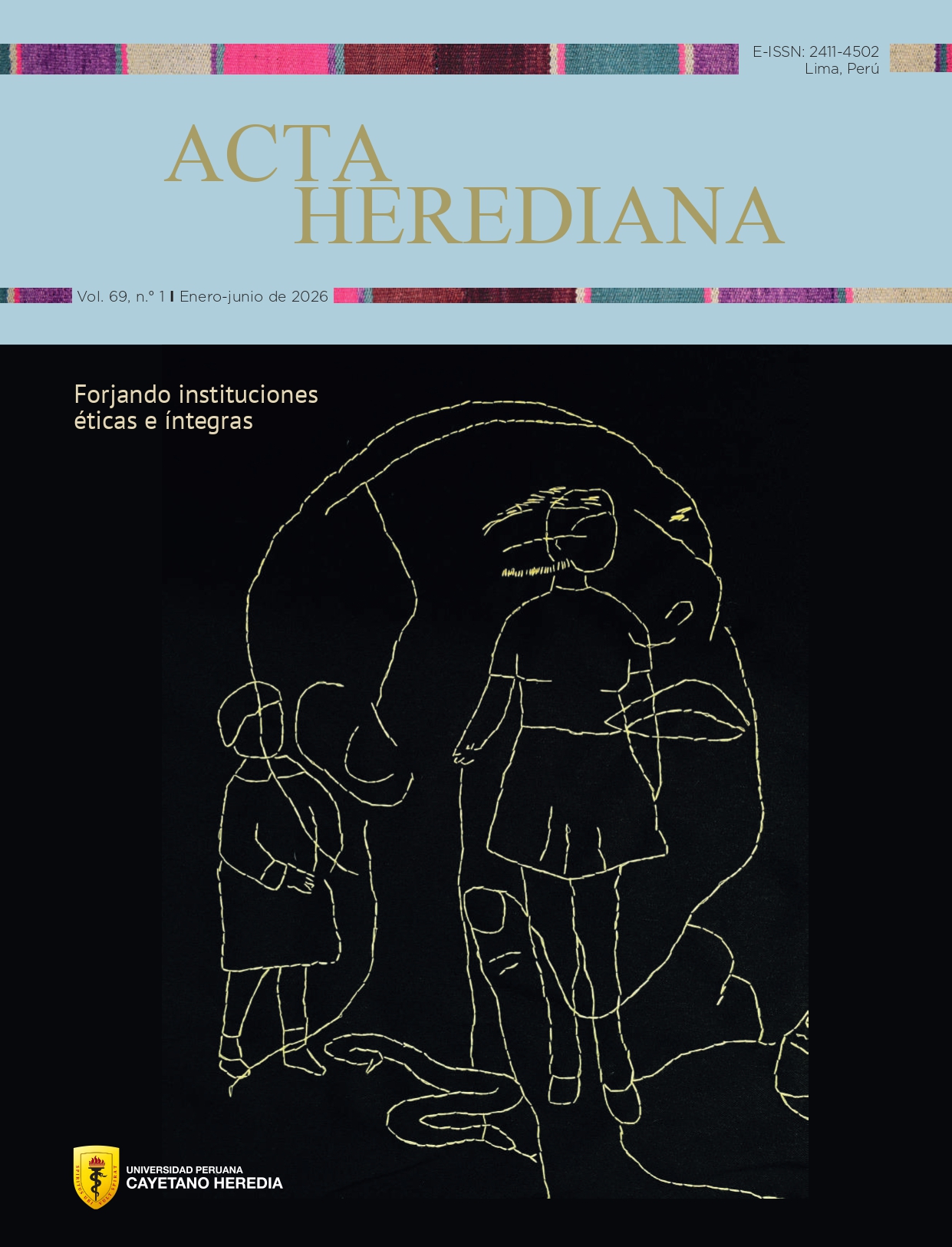
Derechos de autor 2026 Carla Arosquipa-Rojas, Adrián Chamorro-Alzamora

Esta obra está bajo una licencia internacional Creative Commons Atribución 4.0.
Todos los artículos publicados en la revista Acta Herediana están protegidos por una una licencia Creative Commons Reconocimiento 4.0 Internacional, que permite a terceros utilizar lo publicado siempre que mencionen la autoría del trabajo, y a la primera publicación en esta revista.