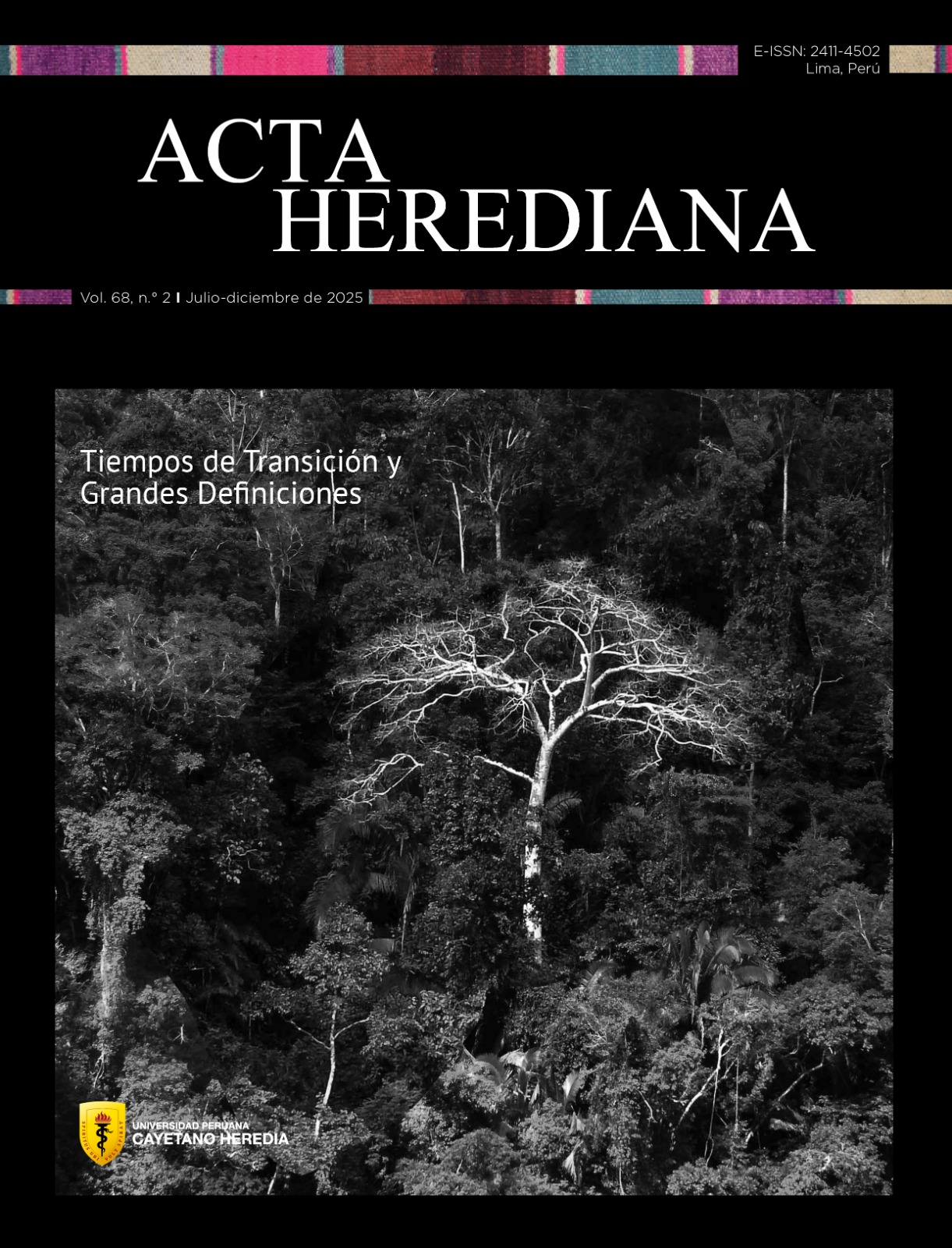
Artificial intelligence: towards an ethical governance
DOI:
https://doi.org/10.20453/ah.v68i2.7505Keywords:
AI governance, ethics and technology, public policy, Latin AmericaAbstract
The accelerated advancement of artificial intelligence (AI) in Latin America has redefined institutional dynamics and highlighted the urgency of establishing robust ethical governance frameworks capable of balancing innovation, regulation, and the protection of rights. This article analyzes the conceptual foundations of ethical AI governance, regional progress, and the current situation in Peru, integrating recent evidence from multilateral organizations and academic studies. Based on this examination, structural gaps are identified in institutional capacities, digital infrastructure, and algorithmic oversight mechanisms, as well as opportunities to strengthen transparency, public accountability, and regional cooperation. The analysis concludes by emphasizing the need to build trustworthy AI ecosystems that integrate ethical standards, technical capabilities, and coherent regulatory frameworks, which constitute the basis for a future agenda for research and public action.
Downloads
References
Criado, J. I. (2021). Inteligencia artificial: Madurez tecnológica, adopción e innovaciones en la gestión pública. En Centro Latinoamericano de Administración para el Desarrollo (CLAD) (ed.), Inteligencia artificial y ética en la gestión pública (pp. 11-44). CLAD. https://issuu.com/clad_org/docs/libro_7_inteligencia_artificial_y__tica_en_la_gest
Ismail, O. H., & Ahmad, N. (2025). Ethical and Governance Frameworks for Artificial Intelligence: A Systematic Literature Review. International Journal of Interactive Mobile Technologies (iJIM), 19(14), 121-136. https://doi.org/10.3991/ijim.v19i14.56981
Miranda-Hospinal, O., Villodre, J., Valle-Cruz, D., & Angulo-Sánchez, K. (2024). Exploring the impact of artificial intelligence on the transparency and rationality of Peruvian public works: perceptions, expectations, challenges and opportunities. Transforming Government: People, Process and Policy. https://doi.org/10.1108/tg-07-2024-0167
Nangoy, A. A., & Chan, P. (2025). Toward Ethical AI: Strategies for Responsible AI Governance. Journal of Business and Management Studies, 7(5), 145-155. https://doi.org/10.32996/jbms.2025.7.5.13
OECD & Corporación Andina de Fomento (CAF) (2022). The Strategic and Responsible Use of Artificial Intelligence in the Public Sector of Latin America and the Caribbean. OECD Public Governance Reviews; OECD Publishing. https://www.oecd.org/content/dam/oecd/en/publications/reports/2022/03/the-strategic-and-responsible-use-of-artificial-intelligence-in-the-public-sector-of-latin-america-and-the-caribbean_17c90e5e/1f334543-en.pdf
Oxford Insights (2024). Government AI Readiness Index 2024. Oxford Insights. https://oxfordinsights.com/ai-readiness/ai-readiness- index/?#download-reports
Saidin, S. S., Ahmad, N., & Aziz, S. (2025). Ethical Governance of Artificial Intelligence in Organizations: Challenges and Strategies. In E. Ahmed, A. Babar, A. Samad, R. Ahmed & G. Beydoun (eds.), Strengthening Human Relations in Organizations With AI (pp. 59-82). IGI Global Scientific Publishing. https://doi.org/10.4018/979-8-3693-6507-6.ch003
Soto, Á., Durán, R., Moreno, A., Adasme, S., Rovira, S., Jordán, V., y Poveda, L. (coords.) (2025). Índice Latinoamericano de Inteligencia Artificial (ILIA) 2025. Documentos de Proyectos (LC/TS.2025/68). Comisión Económica para América Latina y el Caribe y Centro Nacional de Inteligencia Artificial. https://indicelatam.cl/wp-content/uploads/2025/10/Documento_ILIA_2025.pdf
Yeung, K. (2020). Recommendation of the Council on Artificial Intelligence (OECD). International Legal Materials, 59(1), 27-34. https://doi.org/10.1017/ILM.2020.5
Zambrano, O., Talavera-Ruz, M., y Niño Peñalosa, J. A. (2025). Desafíos regulatorios de la inteligencia artificial en la comunidad andina y oportunidades para el emprendimiento digital. Ciencia UNEMI, 18(49), 122-136. https://doi.org/10.29076/issn.2528-7737vol18iss49.2025pp122- 136p
Downloads
Published
How to Cite
Issue
Section
License
Copyright (c) 2025 Alfredo Estrada

This work is licensed under a Creative Commons Attribution 4.0 International License.
All articles published in Acta Herediana are under a Creative Commons Reconocimiento 4.0 International license.
The authors retain the copyright and grant the journal the right of first publication, with the work registered with the Creative Commons License, which allows third parties to use what is published whenever they mention the authorship of the work, and to the first publication in this magazine.
Authors can make other independent and additional contractual agreements for the non-exclusive distribution of the version published in this journal, provided they clearly indicate that the work was published in this journal.
The authors can file in the repository of their institution:
The research work or thesis of degree from which the published article derives.
The pre-print version: the version prior to peer review.
The Post-print version: final version after peer review.
The definitive version or final version created by the publisher for publication.