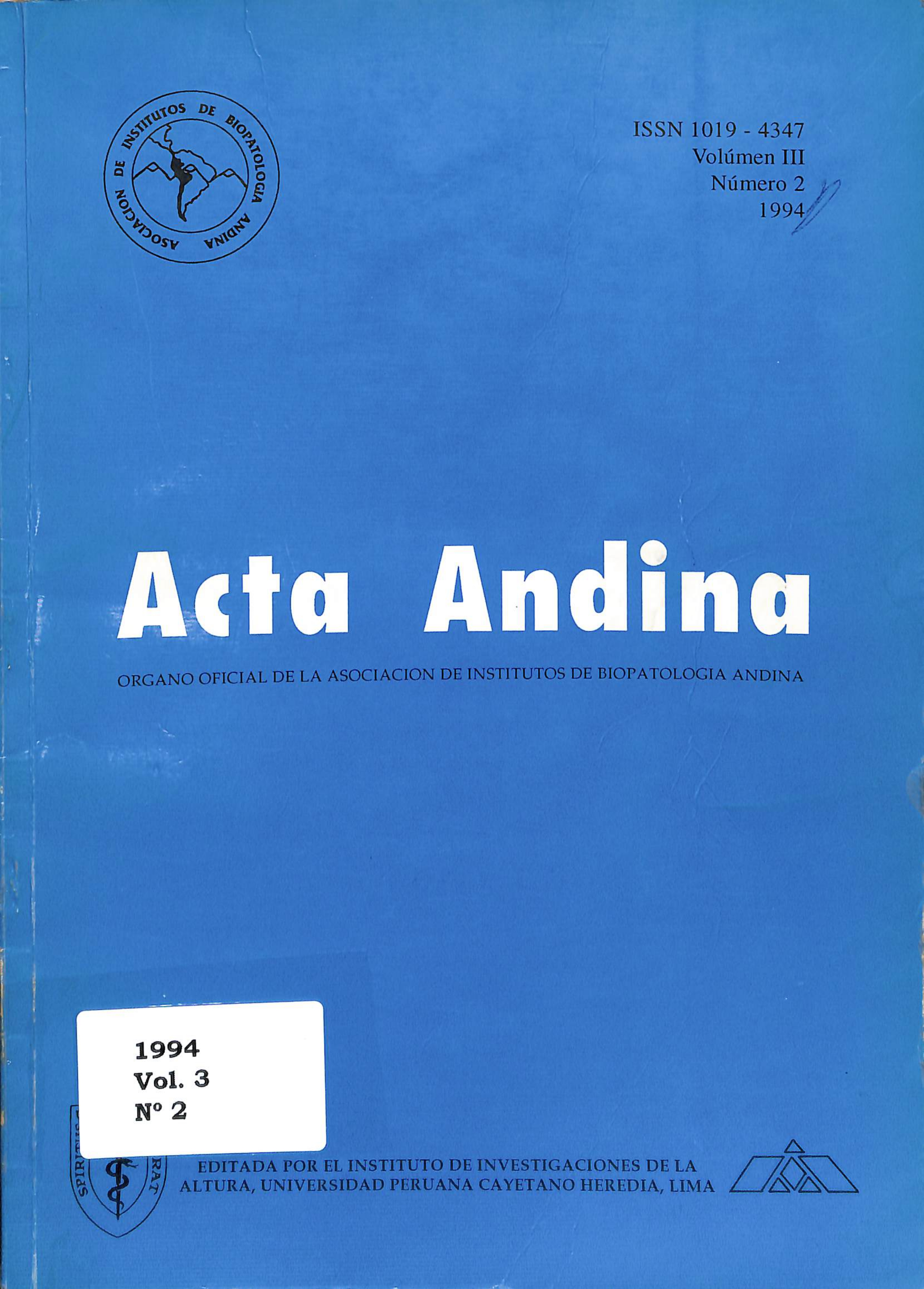
Acción de la prolactina en los niveles de testosterona plasmática en ratas sometidas a hipoxia de altura
Keywords:
testicular function, hyperprolactinemia, prolactin, testicles, hypoxiaAbstract
A group of male rats born at sea level (SL) were transported at 70 days of age to high altitude (Morococha, 4540 m); a second group was maintained at sea level (control). The purpose of the study was to determi ne the effect of hypo and hyperprolactinemia produced by a dopaminergic compound, bromocriptine (CB-154, Sandoz): 4mgr/k.BW. each 7 days and an antidopaminergic, sulpiride (Dogmatil, Spedrog): 1.5 mgr/k.BW. twice a week, respectively, upon testicular function. After 28 days of treatment, body and testicular weight, serum prolactin, and testosterone levels measured. by radioimmunoassay and frequency of testicular damage by light microscopy were assessed. Rats acutely exposed to high altitude showed higher serum prolactin and testosterone levels and high frequency of testicular damage than at sea level. Body but not testicular weight were affected by exposure to high altitude. No further change in body or testicular weight, or in the frequency of testicular damage were observed by effect of bromocriptine or sulpiride. A poligonal correlation was observed between serum prolactin and testosterone levels. Hypoprolactinemia. and hyperprolactinemia were associated to low serum testosterone levels. In conclusion, exposure of male rats to hypoxia of high altitude resulted in an increased secretion of testosterone, which seems to be due, at least in part, to an increased secretion of prolactin.
Downloads
Downloads
Published
How to Cite
Issue
Section
License
Copyright (c) 2024 Elydia Mujica

This work is licensed under a Creative Commons Attribution-NonCommercial 4.0 International License.
Los autores conservan los derechos de autor y de ser el manuscrito aceptado para publicación, los derechos de edición, patrimoniales y el derecho de primera publicación pertenecerán a la Revista Acta Andina, con el trabajo registrado con la Licencia de Creative Commons, que permite a terceros utilizar lo publicado siempre que mencionen la autoría del trabajo, y a la primera publicación en esta revista.
Los autores pueden realizar otros acuerdos contraactuales independientes y adicionales para la distribución no exclusiva de la versión publicada en esta revista, siempre que indiquen claramente que el trabajo se publicó en esta revista.
Los autores puede archivar en el repositorio de su institución:
El trabajo de Investigación o Tesis de grado de la cual derive el artículo publicado.
La versión pre-print: la versión previa a la revisión por pares.
La versión Post-print: versión final posterior a la revisión por pares.
Todos los artículos publicados en la Revista Acta Andina están bajo una licencia Creative Commons Reconocimiento 4.0 Internacional.